
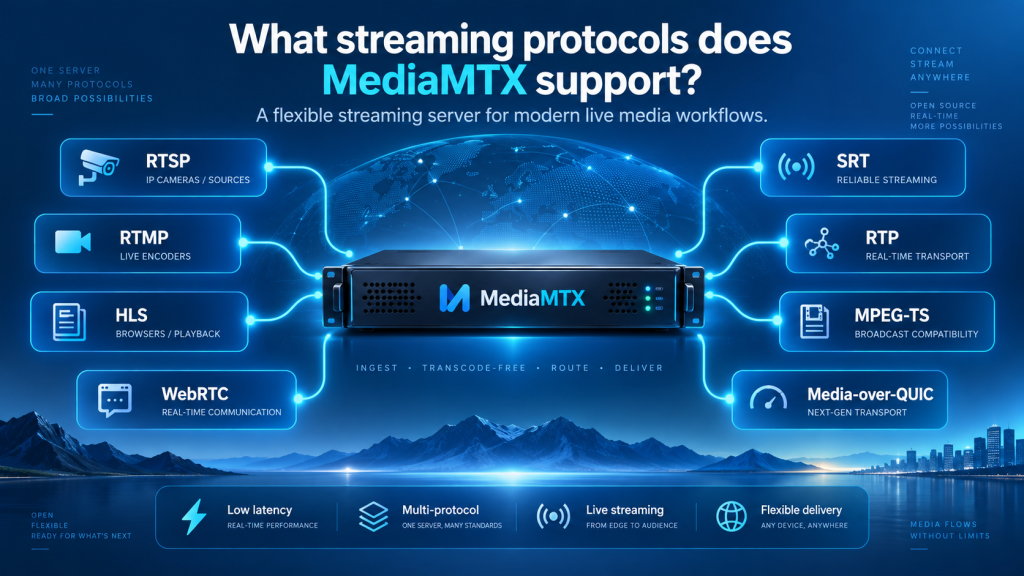
MediaMTX is a useful keyword for anyone exploring the streaming protocols supported by MediaMTX. It is an open-source live media server and media proxy designed to publish, read, route, record, and manage real-time video and audio streams through several widely used technologies.
Instead of building separate infrastructure for every streaming method, users can connect cameras, broadcasting software, browsers, and media applications to a single MediaMTX server. Its multi-protocol design makes it useful for live broadcasting, surveillance, web streaming, remote monitoring, and professional media workflows.
MediaMTX Protocol Support at a Glance
MediaMTX supports a broad range of streaming protocols, but not every protocol is used in exactly the same way. Some are ideal for publishing streams, while others are better suited for browser playback, low-latency delivery, or reliable transmission over difficult networks.
| Protocol | Main Purpose | Typical Use |
|---|---|---|
| RTSP | Real-time streaming | IP cameras and surveillance |
| RTMP | Stream publishing | OBS and broadcasting |
| HLS | HTTP-based playback | Browsers and large audiences |
| WebRTC | Ultra-low latency | Interactive and browser streaming |
| SRT | Reliable transmission | Professional remote contribution |
| RTP | Real-time media transport | Specialized media systems |
| MPEG-TS | Broadcast transport | Professional video ingest |
| Media-over-QUIC | Modern low-latency delivery | Emerging streaming applications |
Understanding the strengths of each protocol makes it easier to choose the right combination for a particular streaming project.
RTSP for Cameras and Real-Time Video
RTSP, or Real-Time Streaming Protocol, is one of the most important protocols supported by MediaMTX. It is widely used by IP cameras, surveillance platforms, video management systems, and professional real-time streaming applications.
Why RTSP Is Useful
MediaMTX can work with RTSP streams for both publishing and playback. This means a camera or application can send an RTSP stream to MediaMTX, while compatible viewers can connect to the server and watch that stream.
RTSP is particularly valuable when MediaMTX acts as a central hub for multiple network cameras. Tools such as FFmpeg, GStreamer, VLC, and other compatible clients can also interact with RTSP streams.
Best Use Cases
RTSP is generally a strong choice for surveillance, internal monitoring, camera networks, and technical video systems where low delay and direct stream access are important.
RTMP for Broadcasting Workflows
RTMP remains widely used for sending live video from broadcasting and encoding software. MediaMTX can accept RTMP streams and make them available through compatible output protocols.
RTMP With Broadcasting Software
Applications such as OBS Studio commonly use RTMP for live publishing. This makes the protocol familiar to streamers, broadcasters, and content creators who already work with live encoding software.
MediaMTX can receive an RTMP feed and route the same media toward other compatible delivery methods. This allows RTMP to serve as an ingest protocol while viewers use a different technology.
Enhanced RTMP Support
MediaMTX also supports Enhanced RTMP capabilities, which expand codec flexibility beyond older traditional RTMP workflows. This helps the protocol remain useful in more modern streaming environments.
HLS for Browser-Friendly Streaming
HLS, or HTTP Live Streaming, is designed for delivering video through standard HTTP infrastructure. It divides a stream into small media segments and provides a playlist that compatible players can use for continuous playback.
Why HLS Is Popular
HLS is widely supported across browsers, mobile devices, media players, and smart devices. MediaMTX can generate HLS output, making it a practical choice when viewers need convenient web-based access.
HLS also works well with HTTP-based infrastructure and content delivery systems, which makes it suitable for reaching larger audiences.
Low-Latency HLS
MediaMTX supports Low-Latency HLS as well. This approach reduces the delay between the source and viewer compared with traditional HLS while retaining many of the compatibility benefits of HTTP-based streaming.
WebRTC for Low-Latency Streaming
WebRTC is one of the best choices when very low latency is required. It is commonly associated with browser-based communication, interactive video, monitoring systems, and real-time applications.
Browser-Based Delivery
MediaMTX allows WebRTC streams to be published and read, making it possible to build browser-oriented streaming systems without relying entirely on traditional desktop media players.
It also supports modern WebRTC workflows such as WHIP for stream ingestion and WHEP for stream delivery. These standards can make integration cleaner for developers working with modern streaming applications.
Where WebRTC Works Best
WebRTC is especially useful for live monitoring, remote control, interactive streaming, conferencing-style systems, and scenarios where several seconds of delay would be unacceptable.
SRT for Reliable Network Transmission
SRT, or Secure Reliable Transport, is designed to move live media reliably across unstable or unpredictable networks. It combines low-latency delivery with retransmission and security features.
Why Broadcasters Use SRT
Professional broadcasters often use SRT when sending video between remote locations and a central server. It performs well in situations where packet loss or varying network quality could otherwise interrupt a stream.
MediaMTX can work with SRT streams as part of a larger multi-protocol workflow, making it useful for contribution feeds and remote production environments.
Security and Reliability
SRT includes encryption and recovery mechanisms that make it attractive for professional streaming over public networks. It is commonly used together with MPEG-TS for transporting audio and video.
RTP and MPEG-TS for Specialized Workflows
MediaMTX also supports RTP and MPEG-TS publishing, which is valuable for advanced video, networking, and broadcast systems.
RTP for Real-Time Media
RTP, or Real-time Transport Protocol, is designed to carry audio and video across IP networks. It is commonly used as part of professional or custom media pipelines where developers need direct control over real-time transport.
MPEG-TS for Broadcast Environments
MPEG-TS is widely used in broadcasting and professional video distribution. It can carry multiple audio, video, and metadata streams in a format designed for continuous transmission.
These protocols may be less familiar to everyday users than RTMP or HLS, but they give technical teams additional flexibility when connecting legacy equipment and specialized infrastructure.
Media-over-QUIC for Modern Streaming
MediaMTX also supports Media-over-QUIC, an emerging approach built around newer internet technologies such as QUIC, HTTP/3, and WebTransport.
Why Media-over-QUIC Matters
QUIC-based transport is designed to provide efficient, modern delivery over internet networks. It can offer advantages in connection handling, latency, and resilience compared with older transport methods.
MediaMTX support for Media-over-QUIC gives developers another option for experimenting with modern streaming architectures and next-generation low-latency applications.
Because the technology is still evolving, it is currently most interesting for developers and advanced users building future-focused streaming systems.
How Multi-Protocol Streaming Helps
The main advantage of MediaMTX protocol support is that sources and viewers do not always need to use the same streaming technology.
For example, an IP camera may send video through RTSP while a web application displays the same stream through HLS or WebRTC. A broadcaster may publish through RTMP while viewers use another protocol better suited to their device or network.
This flexibility can reduce the need to operate multiple independent media servers. Instead, MediaMTX can act as a central routing layer between publishers, cameras, applications, and viewers.
Choosing the Right Streaming Protocol
The best protocol depends on your specific project. Camera systems usually benefit from RTSP, while broadcasters may prefer RTMP or SRT for ingest. Browser viewers often work best with HLS or WebRTC.
| Requirement | Recommended Protocol |
|---|---|
| IP camera streaming | RTSP |
| OBS publishing | RTMP |
| Browser playback | HLS |
| Very low latency | WebRTC |
| Unstable network | SRT |
| Professional media transport | RTP / MPEG-TS |
| Emerging low-latency systems | Media-over-QUIC |
In many cases, a MediaMTX deployment will use more than one protocol at the same time.
Conclusion
MediaMTX offers broad streaming protocol support, making it suitable for many types of real-time media projects. Major technologies include RTSP, RTMP, HLS, WebRTC, SRT, RTP, MPEG-TS, and Media-over-QUIC, although publishing and reading capabilities can vary between protocols.
For developers, broadcasters, surveillance teams, and businesses, this flexibility can simplify media infrastructure considerably. Whether the priority is browser compatibility, ultra-low latency, reliable transmission, camera integration, or professional video ingest, MediaMTX provides multiple protocol options within one lightweight server.